L-Systems
A Blender procedural-generation tool that turns grammar rules into fractal geometry.
Python / Blender API / L-Systems / Formal Grammars / Procedural Generation
Problem
A small set of rules can produce enormous complexity — that’s the promise of Lindenmayer systems. The engineering question is how to expose formal grammars as a practical Blender tool without making users write parser code.
Approach
Implement a string-rewriting engine inside a Blender add-on: users define an axiom and production rules, the system expands them over N iterations, and turtle interpretation converts the resulting symbol strings into geometry.
Architecture
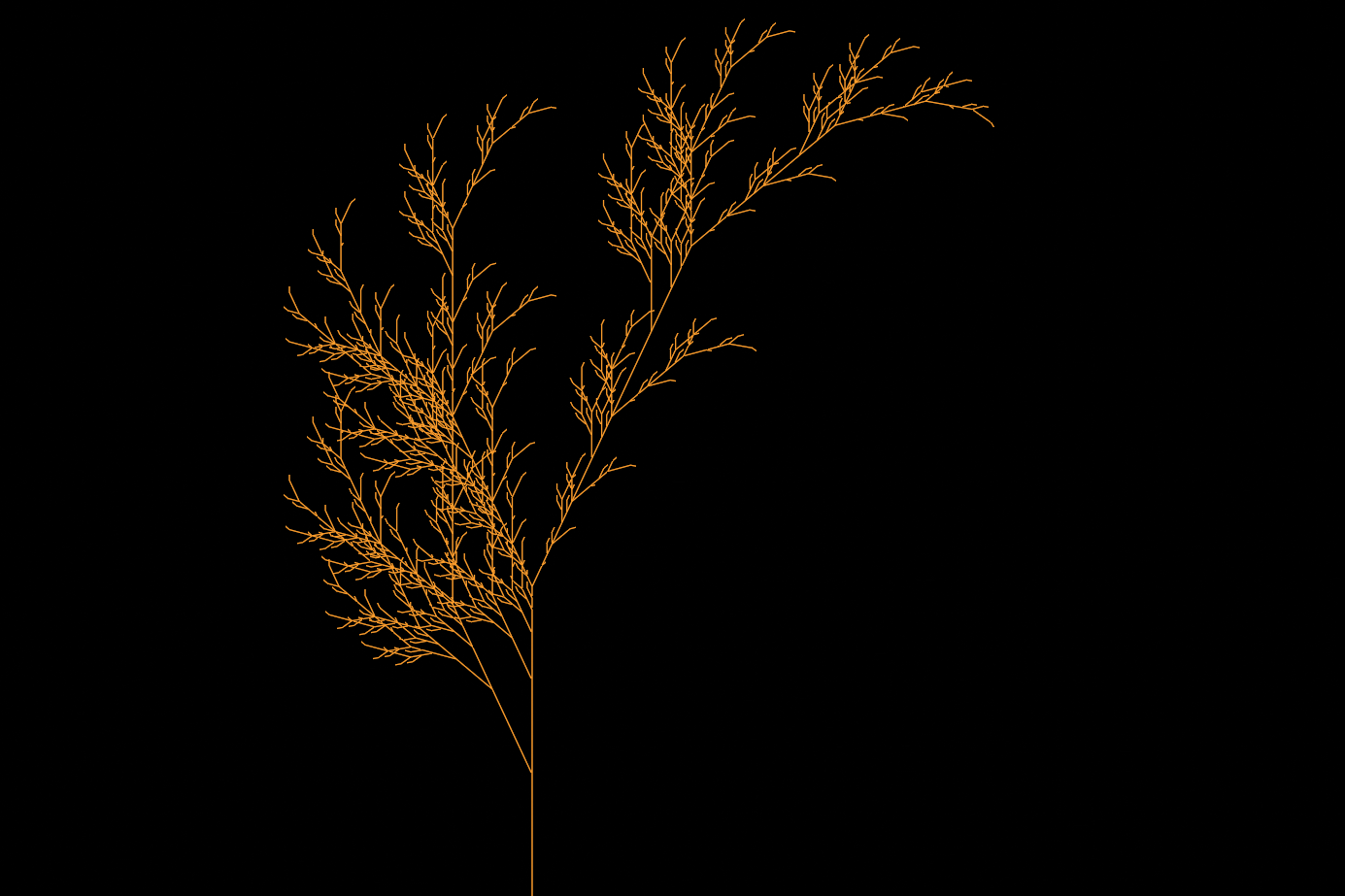
- Grammar engine — axiom + production rules expanded iteratively (Koch curves, snowflakes, dragon curves, fractal plants)
- Turtle interpreter — symbol stream drives position/heading state to generate curves and branches
- State management — push/pop semantics for branching structures
- Geometry output — interpreted paths become Blender curve and mesh objects
Engineering Decisions
- Grammar-first design: the text format is the interface; everything downstream is deterministic interpretation.
- Iteration depth exposed to the user: complexity is a parameter, not a fixed setting.
Result
A tool where typing a handful of characters produces Koch snowflakes, dragon curves, and fractal plants — complex geometry from compact rules.
What I Learned
- Recursive systems are simple to specify and easy to get subtly wrong; state discipline matters.
- Formal grammars are one of the highest leverage-per-line-of-code tools in procedural generation.